
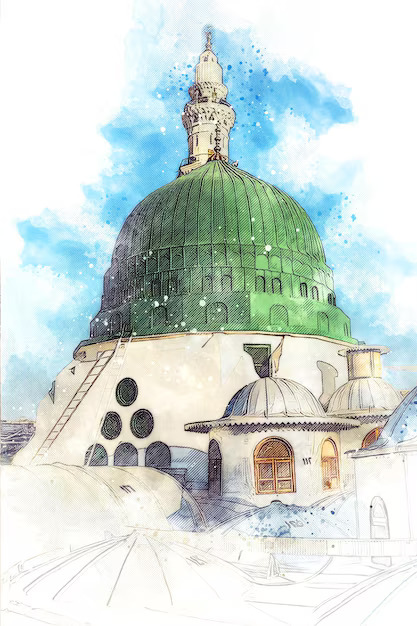
There are many references in which the Prophet sallallahu alaihi wa sallam and his Sahaba radhiallahu anhum partook in poetry. The Prophet sallallahu alaihi wa sallam said, “Truly, in some poetry, there is wisdom.” (Bukhari, Muslim, Abu Dawud) The meaning of this is that there is good poetry in which people receive encouragement towards the Truth, and admonition from wrongdoing as well.
Amr bin Sharid reported his father as saying, “One day when I rode behind Allah’s Messenger sallallahu alaihi wa sallam, he said to me, ‘Do you remember any poetry of Umayya bin Abi Salt?” I said, “Yes.” He said, “Then go on.” I recited a couplet, and he said, “Go on.” Then I again recited a couplet, and he said, “Go on.” I recited one hundred couplets of his poetry.” (Muslim)
The Prophet sallallahu alaihi wa sallam said, “The truest words spoken by a poet were the words of (the pre-Islamic poet) Labid. He said, ‘Lo, everything apart from Allah is vanity and falsehood…” (Bukhari)
Out of his Sahaba radhiallahu anhum, four were particularly well-known for reciting poetry: Abdullah ibn Rawaha, Ka’ab ibn Malik, Ka’ab ibn Zuhair and Hassan ibn Thabit radhiallahu anhum.
In fact, the Prophet sallallahu alaihi wa sallam would let Hassan ibn Thabit radhiallalhu anhu recite poetry while on his mimbar (pulpit) in his mosque, either in praise of the Prophet sallallahu alaihi wa sallam, or in defence of Islam in his presence.
It was Ka’b ibn Zuhayr radhiallahu anhu who so eloquently praised the Prophet sallallahu alaihi wa sallam and the emigrants with his poem Baanat Suaad, and as he finished the 58 verses, the Prophet sallallahu alaihi wa sallam rose up, and wrapped his own cloak (burda) around Ka’b radhiallahu anhu in appreciation. For this reason, the poem is known as the original al Burda.
Ka’b ibn Zuhayr radhiallahu anhu is regarded as the father of the Madeeḥ genre, or poems in praise of the Prophet sallallahu alaihi wa sallam. According to historical accounts, Ka’b radhiallahu anhu recited his poem to the Prophet sallallahu alaihi wa sallam by way of apology.
To sing poetry in praises of the Prophet sallallahu alaihi wa sallam is permissible and generates love for him. This in turn should increase one’s Imaan (faith) and spur one to emulate the Sunnah. It is very meritorious to praise the Prophet sallallahu alaihi wa sallam.
Selected poems of the Sahaba radhiallahu anhum in praise of the Prophet sallallahu alaihi wa sallam:
- Hassan ibn Thabit radhiallahu anhu. His most well-known poem, which mentions the birth of the Prophet sallallahu alaihi wa sallam, reads:
“And more excellent than you, my eye has never seen,
And more beautiful than you, no woman ever gave birth to;
You were created free from any flaw whatsoever,
As though you were created just the way you wanted.”
(Diwan of Hassan ibn Thabit radhiallahu anhu)
- Kulayb ibn Asad radhiallahu anhu
Kulayb radhiallahu anhu came in a delegation to meet the Prophet sallallahu alaihi wa sallam from Hadramaut (Yemen). He carried with him a cloak that his mother had made for the Prophet sallallahu alaihi wa sallam. When he reached, he accepted Islam, handed over the gift and recited poetry in praise of the Prophet sallallahu alaihi wa sallam, among them these lines:
“You are the Prophet about whom we were informed,
And the Torah and earlier messengers gave us tidings of your advent.”
(Tabaqaat ibn Sa’ad 1:263)
- Abdullah ibn Rawaha radhiallahu anhu. In many verses, he described the sublime beauty of the beloved Prophet sallallahu alaihi wa sallam. An example is the following:
“Even if he had no clear signs within him,
His form alone would suffice as confirmation of his prophethood.”
(Al Isabah 4:75)
- Ali ibn Abi Talib radhiallahu anhu. Among his poetry are the words which praise the Prophet sallallahu alaihi wa sallam:
“How can we live a life of enjoyment and luxury,
after the enshrouding and the burial of the beloved Prophet sallallahu alaihi wa sallam has passed,
For we were forced to face his departure’s sorrow and agony,
and we will never see his equal till we live our lives,
For us you were like a strengthened fortress and a stronghold,
A protected sanctuary in the face of our enemies and foes,
And with this fortress we had reached such heights in our souls,
That can never be reached again nor seen nor shown,
And while we were in your majestic presence,
All day in our sights will be marvels of guidance and light shining bright.”
(Diwan of Ali radhiallahu anhu)
- Hassan ibn Thabit radhiallahu anhu recited these verses when he had seen the Prophet sallallahu alaihi wa sallam in his dream after his demise:
“One sweet night I met you again in my dreams,
Forgetting my sorrows while in your presence,
Sleeping yet believing I was awake in your company,
Only to open my eyes to a second sorrowful parting.
How shall I live amongst the people when none of them is you?
Life is just too painful when it is not lived alongside you.”
(Diwan of Hassan ibn Thabit radhiallahu anhu)
The practice of writing poems in the praise of the Noble Prophet sallallahu alaihi wa sallam has continued through history. Perhaps the most well-known poem specifically about the Prophet sallallahu alaihi wa sallam’s birth and early life was by Imam al-Barzanji rahimahullah (d. 1766 CE), whose 19-chapter eulogy contains 355 verses. It is recited across the whole of the Muslim world and is particularly famous across large parts of Africa. Between each chapter is recited:
“O Allah, perfume his noble grave with the fragrant scent of blessings and peace,
O Allah, honor, bestow peace, and shower blessings upon him and his family.”
Imam al-Barzinji rahimahullah was made the Shafi Mufti of Madinah Munawwarah because of his knowledge, piety, and virtue. He died in the city and is buried in Jannat al-Baqi. Among the rulers, Sultan Abdul Hamid I of the Ottoman Empire also composed poetry in praise of the Prophet sallallahu alaihi wa sallam.

COMMENTS