
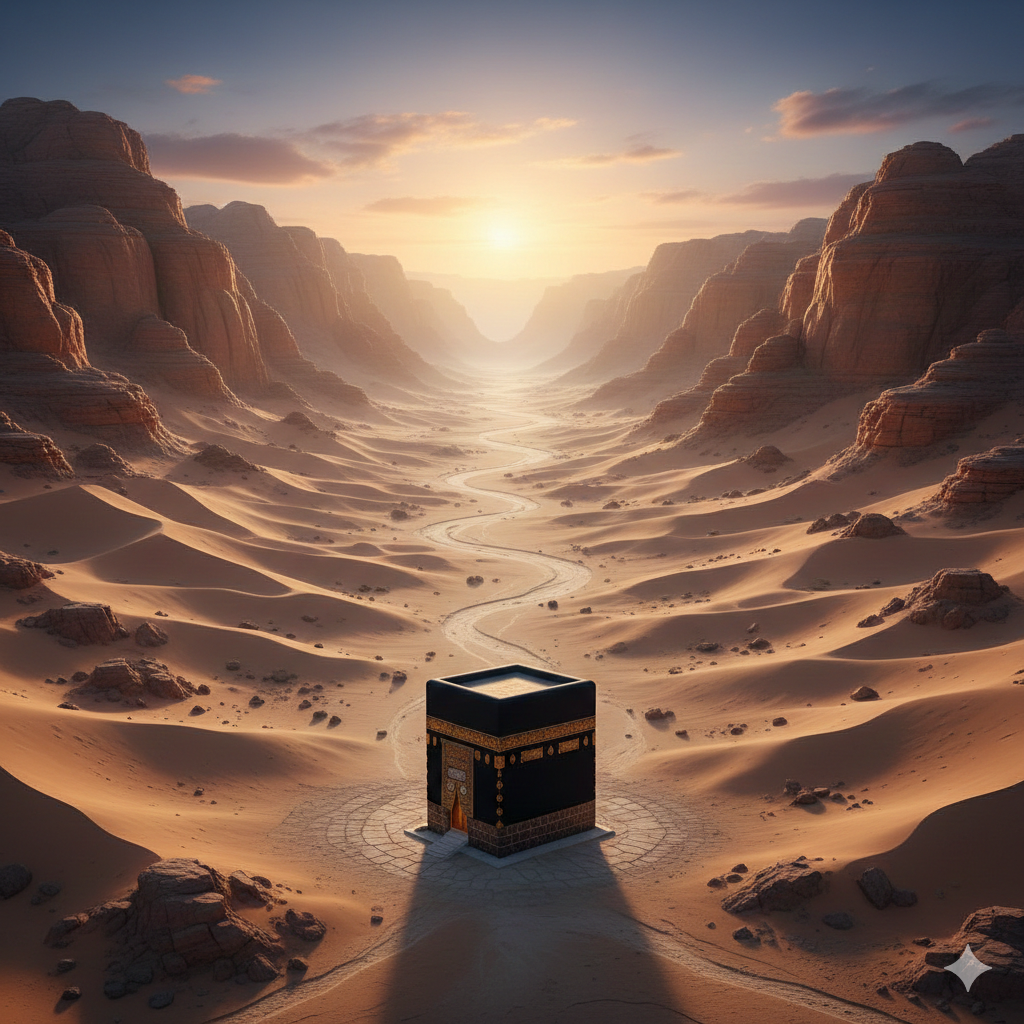
As a testament to the perfection of Allah Ta’ala’s religion of Islam and His beautiful bounty on the Muslims, Islam is not only a way of life but it is relevant to every season of life. When Allah Ta’ala takes an oath by time, it not only demonstrates the value of time but the relevance of Islam to every moment and season of life.
While we celebrate the season of Hajj, we also wander through the darkness that overshadows the Muslim community worldwide. As we search for light in the darkness, we must turn to the illuminating lessons presented by the very season of Hajj.
Whilst the season of Hajj is symbolic of many a great thing, the greatest symbolism for the Muslims is that Hajj, in the words of Imam Ghazali, represents the culmination, perfection, and completion of this beautiful religion. In the 10th year after Hijrah on the 9th Zul Hijjah, on the plains of Arafah, Allah Ta’ala revealed the verse of Quran, “Today, I have perfected your religion for you, and have completed My blessing upon you, and chosen Islam as a religion and a way of life for you.” (Noble Quran 5:3)
As Allah Ta’ala had selected the 9th day of Zul Hijjah and the plains of Arafah and the act of worship of Hajj for the culmination and completion of his religion so too has Allah Ta’ala selected you and I to be the followers of this divinely perfect way of life. Allah Ta’ala declares in Surah Hajj, “Strive for Allah, a struggle that is owed to Him. He has chosen you and did not impose any hardship on you in the religion, the faith of your father Ebrahim. He (Allah) named you as Muslims earlier and in this (Quran)…” (Noble Quran 22:78)
Consequently, from this verse we understand that there is an intrinsic relationship between ourselves and Ebrahim alaihis salaam and as such there is a deep lesson to be learned from his life: his supreme reliance on Allah Ta’ala and the fervour of his faith coupled with his unquestionable sacrifice culminated in the blossoming of a once barren land.
The Noble Quran gives expression to the hope and dua of Ebrahim alaihis salaam in Surah 14, verse 37:
“Our Lord, I have settled some of my children in a valley of no vegetation, close to Your sanctified House, so that, Our Lord, they may establish Salaah. So make hearts among the people incline toward them and provide for them from the fruits that they might be grateful.”
How many of us long to be in Mina, despite the scorching heat of the Makkan sun? How many people across the globe wait anxiously, for 10, 20, even 40 years to perform Hajj despite the barren landscape of Makkah Mukarramah?
As Ebrahim alaihis salaam’s faith and sacrifice resulted in Makkah flourishing as a civilization, it is our faith and sacrifice that will lead to the Muslim community flourishing as a nation. You have been chosen to follow Ebrahim alaihis salaam and you have been chosen to sacrifice like Ebrahim alaihis salaam.
It is this legacy of Ebrahim alaihis salaam of being devoted in his belief in Allah Ta’ala, which earned him the accolade of Abu Tawheed, the father of monotheism. Whilst we rightfully speak of Ebrahim alaihis salaam in the context of Qurbani, sacrifice and of course Hajj, the greatest legacy of Ebrahim alaihis salaam was his yearning to find Allah Ta’ala.
When a young Ebrahim alaihis salaam saw his community engaged in idol worship he realised that he could not worship that which was made by the hands of man. To prove to his people that worshipping celestial bodies did not make sense, Ebrahim alaihis salaam directed them to search for the creator in the stars, the moon and the sun. But as these cosmic bodies vanished he showed them that his Lord, majestic and supreme, does not wither. Ebrahim alaihis salaam said, “I am going to my Lord. He will guide me.” (Noble Quran 37:99) It is this movement towards Allah Ta’ala that is the essence of Hajj. Hajj in the Arabic language means al qasd ilaa muzam, an undertaking or exertion to that which is high and lofty. So while Hajj represents a physical movement of people from all parts of the globe to the exalted plains of Arafah, for you and I, it is a spiritual movement towards the recognition of the most Exalted.
Every act of religiosity is geared towards the recognition of Allah. Allah Ta’ala informs us, “I did not create the Jinn and the human beings except for the purpose that they worship Me.” (Noble Quran 51:56)
Man has been created for the sole worship of Allah Ta’ala. Mujaahid ibn Jabr, the 7th century scholar of Tafseer explained worship in the context of this verse meant to recognize Allah Ta’ala. The purpose of creation is the recognition of Allah Ta’ala: Salah is to get closer to Allah Ta’ala, fasting is to become conscious of Allah Ta’ala and Hajj is to hand yourself over to Allah Ta’ala.
What strikes one about Hajj is the mode in which Allah Ta’ala conveys the obligation of Hajj. “As a right of Allah, it is obligatory on the people to perform Hajj of the House (Ka’bah).” (Noble Quran 3:97) No other act of worship has been commanded in a manner so intrinsically connected to the being of Allah Ta’ala, the majesty of Allah Ta’ala and the recognition of Allah Ta’ala than that of Hajj. For Allah and Allah Ta’ala alone is the Hajj.
It is this recognition of Allah Ta’ala so deeply embedded in the heart of Ebrahim alaihis salaam that is best expressed through his submission to Allah in the words, “My prayer, my offering of sacrifice, my life and my death are for Allah, the Lord of all the worlds.” (Noble Quran 6:162) Returning from Hajj marks the pinnacle of one’s devotions to Allah Ta’ala, of having handed his every existence over to Allah Ta’ala.
It recorded in Al Risalah al Qushairiyyah by Abu Bakr al Kattani that Abdul Qadr Jailani was once asked what it is to love Allah Ta’ala. He paused, reflected and then his eyes started to brim with tears as he said,
“The one who has recognised Allah Ta’ala is one who has become oblivious of himself, engrossed in the remembrance of Allah Ta’ala, steadfast in the execution of the command of Allah Ta’ala. The gaze of his heart is set on Allah Ta’ala. The light of Allah Ta’ala’s awe, majesty and greatness has been burnt into his heart and he has drank from the cup of Allah Ta’ala’s love. Finally, Allah has revealed to him His recognition from behind his curtain of concealment. So if he speaks, he is conscious of Allah Ta’ala, if he speaks it is only about Allah Ta’ala. If he moves or stops it is under the command of Allah Ta’ala. He belongs to Allah Ta’ala, his mind is with Allah Ta’ala and he lives for Allah.” (Al Risalah al Qushairiyyah 2:493)
“My prayer, my offering of sacrifice, my life and my death are for Allah, the Lord of all the worlds.” This is the meaning of, “As a right of Allah, it is obligatory on the people to perform Hajj of the House (Ka’bah).”
The Prophet sallallahu alaihi wa sallam explained that Hajj is Arafah, but what is Arafah? The word Arafah shares the root letters with the word marifah which means to recognise. It is the place where we acknowledge our wrongs and recognise the greatness of Allah Ta’ala. Arafah is five hours in the blazing heat of the desert crying one’s heart out to Allah Ta’ala. Standing on those plains with full conviction that our lives are totally in the control of Allah Ta’ala.
Hajj is Arafah and Arafah is Dua. The Prophet sallallahu alaihi wa sallam explains that “Dua is the core and essence of worship.” (Tirmidhi 3371) Remember Mujahid ibn Jabar said that worship is to recognise Allah Ta’ala. Dua is at the centre or core of worship because when we have lost faith in this world and we turn to Allah Ta’ala we do it with the greatest of sincerity and full recognition that all has failed us and only Allah Ta’ala can save us.
This brings us to the final point, that coupled with our faith in Allah Ta’ala is our sacrifice for Allah Ta’ala. The Noble Quran is filled with instructions of faith coupled with action. Great scholars of Tasawwuf (self-reformation) of the past understood that faith demands sacrifice. Imam Shamil of the Naqshbandi Sufi order fought against the Russian Empire, Sheikh Abdul Qadr Jailani wrote extensively about standing up for justice, and Sheikh Omar al Mukhtar, a student of the Senussi Sufi order, led the Libyan resistance against the Italians.
While we celebrate Hajj we do so on the backdrop of a genocide taking place in real time in Gaza. The lessons from the life of Ebrahim alaihis salaam lead us to an understanding that we must have complete reliance on Allah Ta’ala, particularly when we have lost faith in the world. Being ostracized by our community does not mean defeat, being thrown into the blazing fire does not mean defeat, leaving our family in a barren landscape does not mean defeat, being asked to sacrifice our children does not mean defeat.
With a firmness of faith and a willingness to sacrifice we will be rejoiced by the world despite our own people disregarding us, we will find peace in the heat despite the flames of the fire and we shall flourish as a nation despite our desolate situation.
Hajj is a clarion call not only for us to strengthen our faith in Allah Ta’ala but to understand that our faith demands of us action and sacrifice. As two million Muslims complete the rights of Hajj, two million Muslims face a starvation and genocide in Gaza. The reality of the situation is that despite the tremendous terror the people of Gaza face, they have shown us the fervor of their faith, and modern-day examples of the sacrifice of Ebrahim alaihis salaam.
Hajj is a microcosm of how we ought to live our life as Muslims. This is why we revere the Haji (pilgrim) and it is why people hope to change their lives after Hajj.
If Hajj is meant to teach us how to live our lives as Muslims, it not only teaches about faith and sacrifice, but it teaches solidarity within the Muslim community. It teaches that we are one, and that all Muslim life is sacred.
As Ebrahim alaihis salaam made a call for Hajj that to this day is being answered, let us respond to that call by strengthening our faith in Allah Ta’ala, let us sow the seeds of sacrifice so that the Muslim nation may blossom watered by our blood and sweat.
Adapted from a talk by Moulana Salmaan Fredericks

COMMENTS