
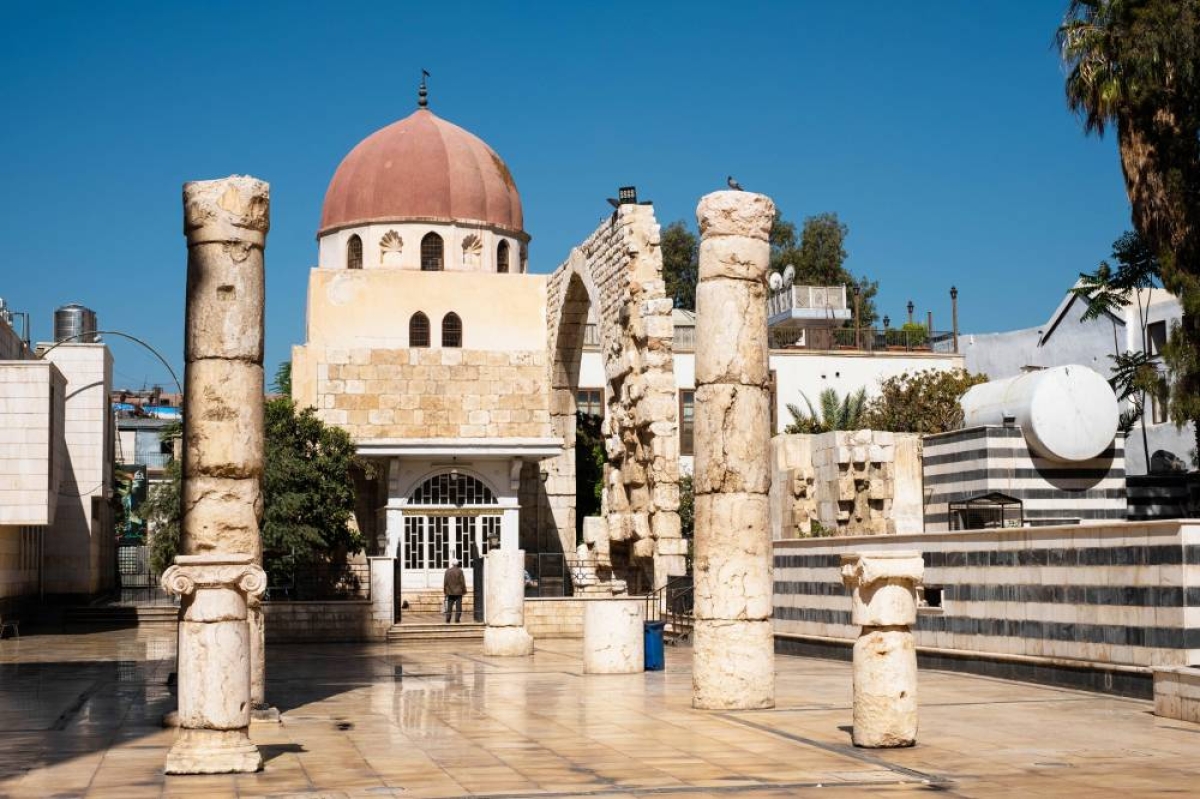
We had the opportunity to make a brief visit to Syria in October 2025. These are some reflections on what was a far too short travel to a historically rich land.
Why should a Muslim add Syria to his or her travel bucket list?
- It is a blessed land. “And We rescued him (Ebrahim alaihis salaam) and Lut towards the land which we blessed for all the worlds.” (Noble Quran 21:71) Allah Ta’ala saved Prophet Ebrahim and Lut alaihimas salaam and took them to a land which He had blessed which is identified as Shaam and includes Syria.
- The Prophet sallallahu alaihi wa sallam said, “It will be such that many armies will be gathered. An army in Shaam, an army in Iraq and an army in Yemen.” A companion asked, “If I live that long, which do you choose for me?” The Prophet sallallahu alaihi wa sallam said, “I choose Shaam for you, because it is the best of places, and the land that Allah has chosen for his special servants – and if you cannot go to Shaam, then go to Yemen – and drink from your brooks and streams, for Allah Ta’ala has guaranteed that He will look after the land of Shaam and its inhabitants.” (Abu Dawud 2475) Shaam covers modern day Syria, and the Hadith designates it as a chosen land.
- It is a land guarded by Angels: The Prophet sallallahu alaihi wa sallam said, “Glad tidings for Shaam.” We asked, “Why is that O Messenger of Allah sallallahu alaihi wa sallam?” He replied, “Because the angels of Al Rahman spread their wings over it.” (Tirmidhi 3954)
- Great Islamic events have taken place in Syria. Travel there to gain an understanding of Muslim history.
- Syria will play a significant role in coming world events: a. It is the land of resurrection. (Musnad Ahmad, 6:457)
- The Muslim armies will be gathered in Syria at the time of the great tests of Dajjal and events close to Qiyamah: “The place of assembly of the Muslims at the time of the great war will be in Ghouta near a city called Damascus, one of the best cities in Syria. (Abu Dawood 4298)
- The army of the Mahdi will be at the Umayyad Masjid in Damascus when Prophet Esa alaihis salaam will come back to the world: “it would be at (the time of Dajjal) that Allah would send Jesus, son of Mary, and he will descend at the white minaret in the eastern side of Damascus wearing two garments lightly dyed with saffron and placing his hands on the wings of two Angels.” (Muslim 2937)
Syria is the land of Jihad through history and up to present times. It was through the Jihad of the Sahaba radhiallahu anhum that Syria came into the hands of the Muslims. By means of Jihad Nuruddeen Zengi and Salahauddeen Ayyubi rescued it from the Crusaders. The Mongol invasion was pushed back by means of Jihad and once again through Jihad Syria was liberated in 2024 from the 53 year long repressive rule of the Assad family. The Assad regime was propped up in its dying days by the Shia Hizbullah fighters of Labanon, Iranian forces and Russian air strikes. It was the Jihad of the people that met this onslaught and freed the country.
Damascus
We went first to Damascus on our trip. Entering the Damascus airport was a dream come true of walking on such significant soil. Damascus is an ancient city, one of the oldest continuously inhabited in the world. People have lived here for probably 12,000 years. The main focal point of Damascus is the impressive Umayyad Masjid. It is one of the largest and oldest in the Muslim world, built by an early Caliph Walid ibn Abdul Malik. It stands on the site of what was one of the largest Roman temples in Syria and the current walls were the inner walls of the Temple of Jupiter.
The Umayyad Masjid influenced Islamic architecture and was regarded as a wonder of the world by medieval Muslim writers. It still largely maintains the same form of its 1300-year-old construction. It boasts an amazing atmosphere with a large, tiled courtyard. The burial place of Prophet Yahya (John the Baptist) alaihis salaam’s head is located within the Masjid. Caliph Walid’s father Abdul Malik constructed the Dome of the Rock in Al Aqsa, Jerusalem while Walid constructed the Qibli Masjid in Al Aqsa. He also expanded Masjid Nabawi sallallahu alaihi wa sallam in Madinah Munawwarah to include the burial place of the Prophet sallallahu alaihi wa sallam within the building.
Around the Umayyad Masjid in Damascus are old Souqs (marketplaces) and a mix of Roman, Greek, Seljuq, Mamluk and Ottoman era buildings and relics. The grave of the liberator of Aqsa, Salahuddeen Ayyubi is located behind the Umayyad Masjid.
You can wander through the Souqs soaking in the atmosphere especially towards the evenings and nights as people only really start moving by 10am and continue till late at night. There are many well-preserved graves of Sahaba radhiallahu anhum and Ulama in Damascus. The Bab Saghir graveyard contains the resting places of Bilal radhiallahu anhu, the Muazzin of the Prophet sallallahu alaihi wa sallam, and Abdullah ibn Ummi Maktoum radhiallahu anhu about whom Surah Abasa was revealed. It also contains the reputed graves of three noble wives of the Prophet sallallahu alaihi wa sallam, Muaawiya radhiallahu anhu, Caliph Walid and his father Caliph Abdul Malik as well as many Ulama.
One grave that stood out for us was that of Ibn Asakir, incongruously situated on a roundabout in the middle of some streets. We had recently completed a recital of his work on 40 Hadith on the Virtues of Jihad for the relief of Gaza. This was written on the instruction of the great warrior Nuruddeen Zengi who is also buried in Damascus. We then met Sheikh Mujir al Khatib who is the current Sheikhul Hadith at Darul Hadith Nuriyyah, an institution specialising in Hadith, built by Nuruddeen Zengi who appointed Ibn Asakir as the first Sheikhul Hadith. Living history! Among the students of Ibn Asakir was Sultan Salahuddeen. On our return home, Sheikh Mujir consented to hold a reading of the book live from the institute of Ibn Asakir in Damascus. Any scholar will experience a feeling of awe at being part of such a link.
Getting around in Damascus was pretty easy. You will need to bring in cash physically until the banking system is restored. The Syrian Pound was very weak when we were there with $100 getting you 1,1 million pounds. The biggest note was 5,000 pounds which was equivalent to around R7,72 in October 2025. This meant having to carry packets of cash when you needed to do any shopping. Food in the Souqs was quite cheap with a slice of fresh bread (similar to a pizza) being around R9 a slice. R600 got a hearty meal with several dishes and sides for five people at a good restaurant. Note that with the subsequent lifting of crippling sanctions, the infrastructure should improve significantly from the time of our visit and will most likely become even easier to use. Plans are also afoot to stabilise the currency.
Fruit, fish, meat and fresh bread and vegetables are plentiful in Damascus. Agriculture is a backbone of the Syrian economy accounting for 26% of the GDP (by comparison its 2,6% in South Africa). Although 20% of the country is desert, the rest contains fertile farmland producing wheat, olives, grapes, pistachios, almonds, tomatoes, potatoes, citrus fruit and much more grown in abundance in places largely saved from the ravages of the war. The road from Damascus to Aleppo passes large agricultural farms. The sanctions of decades made Syria self-sufficient in terms of food production.
You can move around by hiring a driver with his own car or you can use the taxis. Cars range from a merry mix of the very old to new imports coming in with the lifting of sanctions. The internet was patchy and due to decades of trade restrictions some things might seem a little old fashioned. Hotels are a bit on the expensive side for foreigners, but cheaper places can be found.
Aleppo
After seeing as much as we could in Damascus (which covered only a portion of what’s there to be explored) we travelled to Homs, the city of Khalid ibn Walid radhiallahu anhu. War damage is very evident in the city, unlike Damascus which was largely spared. The Masjid of Khalid ibn Walid radhiallahu anhu contains his resting place and it and the surrounding area suffered large-scale destruction at the hands of Shia fighters. The people of Syria are resilient though, and rebuilding moves at a rapid rate.
We passed briefly through the city of Hama, the site of Hafiz Assad’s brutal crackdown on the Muslims who wanted to live under Islam. From there it was time to go to Aleppo. This is another ancient city, one of the oldest continuously inhabited cities in the world alongside Damascus. People were likely settled there by 8,000 BC. It was the third largest city in the Ottoman Empire after Istanbul and Cairo and played a prominent role on the ancient Silk Road as the western end. Aleppo’s main attraction is the Citadel, one of the oldest and largest castles in the world. The hill on which it sits dominates the city and was in use for 5,000 years. It was occupied at various times by Assyrians, Greeks, Armenians, Romans, Byzantines, Ayyubids, Mamluks and the Ottomans among others.
It endured quite a bit of damage during the recent war and in the devastating 2023 earthquake. Alexander the Great used it, and the Roman Emperor Julian visited it in 363. It was here that Imaduddeen and Nuruddeen held off the Crusaders and Baldwin II and other Crusader leaders were imprisoned. Timur the Turco-Mongol leader destroyed parts of it in his wave of conquest, and it was attacked by the Mongols as well.
One can see severe war damage in Aleppo’s main city areas. It also has an Umayyad Masjid (which was being reconstructed after sustaining war damage) in which Prophet Zakariyya alaihis salaam is buried. The famous Aleppo soap made from olive and laurel oils and has been made the same way for centuries. It was reported to be used by Cleopatra. It is reputed to have health benefits for skin.
Aleppo’s once-vibrant old markets are beginning to come back to life, although scars of war remain, especially from the intense bombing campaigns by Assad and Russian forces. Entering the covered market, visitors are immediately greeted by the familiar scent of soap mixed with spices and incense and by rows of shops filled with traditional goods, handcrafted souvenirs, and, recently, items adorned with the colours of the new Syrian flag.
Idlib: The heart of the liberation
From Aleppo it was time to visit Idlib, a sprawling city close to Turkey. It was here that the internally displaced people of Syria built their refugee camps which were then added to the city. It was here that the Jihad resistance to the Assad regime and the Shia and Russian forces made a base. It was the last outpost of the revolution against the Assads and subsequently served as the launch pad for the liberation of Syria in 2024. The area known as the Ribat was where the Mujahideen implemented a long-term plan to fight back against the Assad forces and their allies. They developed an extensive tunnel system to counteract the Russian airstrikes and keep control of land gains. They started an education campaign to prepare a shadow government alongside an Islamic education syllabus.
In November 2024 they launched an attack to take Aleppo while Russia was tied up in Ukraine and Iran was tied up with Israel. The fearless Asaaib Al Hamraa units, distinguished by red headbands, led the first attacks. They wear the bands in emulation of the Sahabi Abu Dujanah radhiallahu anhu who wore a red headband at the Battle of Uhud and fought courageously. In that battle Khalid ibn Walid radhiallahu anhu was not yet a Muslim and fought on the opposing side. When he came to Islam, Khalid radhiallahu anhu led campaign after campaign against the Romans and Persians and fittingly in the 2024 attacks the Asaaib al Hamra were followed by the Khalid Brigades.
The November 2024 revolution is too long to go into in this article, but it is worth noting some similarities with the past:
- Salahuddeen was not an Arab but a Kurd. Nuruddeen and Imaduddeen who fought the Crusaders were Turkomen. The fighters today included Muslims from various lands, notably Turkmen from Chinese-occupied East Turkestan, as well as military support from Turkey.
- Salahuddeen first dismantled the Shia Fatimid state before liberating Aqsa, and the Mujahideen today had to first neutralise the Shia menace before opening the road to the liberation of Damascus.
The revolution was launched on 27 November 2024. By 29 November Aleppo was liberated, by 5 December the Mujahideen were in Hama and by 8 December they took Damascus. This was described as an unreal dream by the fighters. On our travels we encountered these heroic youth manning checkpoints and treating citizens with respect. A far cry from the repression of Hafez and Bashar Assad.
The people we encountered were some of the friendliest you will ever see. Everyone was willing to help. You get a sense of genuine happiness and euphoria at achieving freedom. People are optimistic but well aware of all the possible ways things could go wrong. Syria is a relatively small country. The drive from Damascus in the southern end to Aleppo in the north only takes about four hours. At various points we were but 50 kilometres away from occupied Palestine, half an hour away from Lebanon and a short drive away from Turkey.
A visit to Syria is a must to connect with Islam’s glorious past and to understand how the future will play out. It gives a glimpse of what it means to be part of an Ummah (common Muslim nation) working towards a united goal. What the future holds no one can accurately predict. There is much work needed to build the country and make it prosperous. Plan a family visit. It is a short flight from Qatar, Dubai or Turkey and an even shorter drive from Jordan. Not many people speak English, but you will find a way to get around. Syria will open your mind to a fascinating past, present and future for Muslims globally.
COMMENTS