
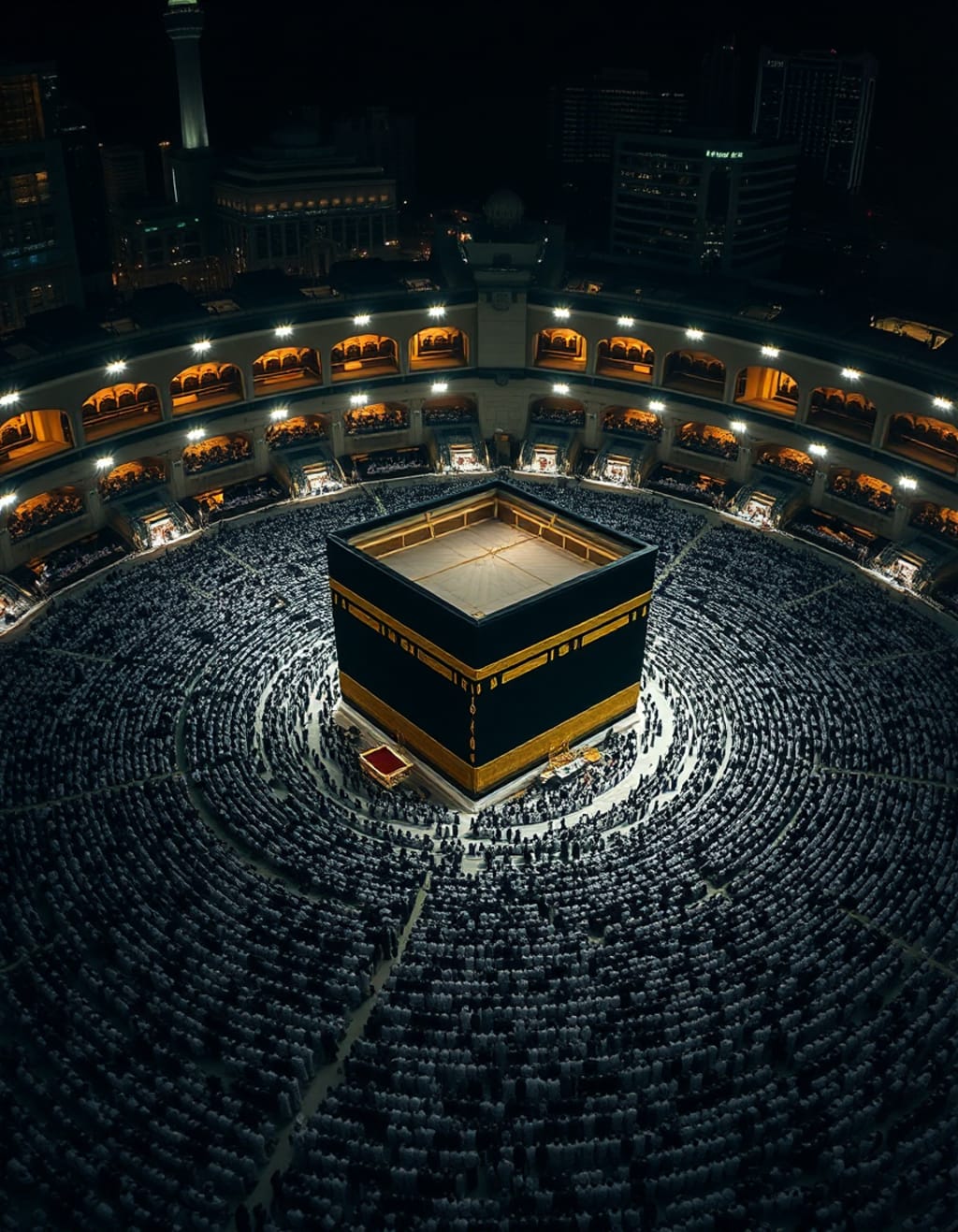
Islam is timeless and not seasonal. It is for all times and all people. Acts of worship are carried out at specified times such as Salaah and Hajj, but the meanings and lessons we derive from them are timeless. The lessons the Hajj pilgrim implements on his sacred journey and which he will take back home are for those who are not on Hajj as well. These lessons need to be taken to heart and renewed annually especially around the Hajj period.
“The Hajj is (to be performed in) the months that are well-known. So, whoever undertakes Hajj in them, there should be no obscenity, no sin, no quarrel in the Hajj.” (Noble Quran 2:197)
This verse of the Noble Quran tells us that the time for Hajj is well-known. It also clarifies that Hajj should be performed without, 1. Obscenity (Rafath), 2. Sin (Fusooq), and 3. Arguments (Jidaal).
- Rafath refers to no intimate relations or talk being allowed between spouses in the state of Ihraam during the Hajj. Here something which is ordinarily permissible outside Ihraam is now forbidden. In fasting as well, eating, drinking and intimate relations are forbidden during that period. This is teaching us how to control our desires. The crowds in Hajj and the mixing of males and females can lead to the sin of immorality even within the precincts of the Holy lands. This is an issue that tends to be ignored but the reality is that when men and women are in close contact over a period, it becomes very difficult not to overstep the limits set by Islam in that interaction. Even the corporate world of high level companies is not free from the harassment and abuse that comes out of such an environment as evinced from books and memoirs of those who worked in those circles.
- Fusooq refers to sin. While sin is prohibited at all times, it becomes more critical to abstain from it during the Hajj.
- Jidaal means quarrelling, arguments and fighting should be avoided during the Hajj. Remember you have only one chance in your life to perform a Fardh (compulsory) Hajj. All other Hajj performed thereafter will be Nafl (optional). A person gets tested in Hajj with the crowds. Lots of things can provoke him. How he responds or reacts to the tests is important.
A person should also not be complaining about his Hajj. When we do Qurbani we are taught to do it with a happy heart. “The big animals of sacrifice are made by Us among the symbols of Allah for you.” (Noble Quran 22:36) We are further instructed, “And whoever honours the symbols of Allah, it is certainly out of the piety of the heart.” (Noble Quran 22:32) Ibn Abbas radhiallahu anhuma said that honouring them means choosing fat, healthy animals to sacrifice. Abu Umamah ibn Sahl said, “We used to fatten the sacrificial animals in Madinah Munawwarah.” (Bukhari) The more expensive something is, the better it is to be offered seeking reward. Ibn Khuzamah rahimahullah said, “The more something is difficult for you to lose, the more reward you get when you give it in charity.” Among the actions that will give a person the taste of faith is giving Zakaat due on his wealth every year with a happy soul. (Abu Dawood 1582) We should spend happily on fulfilling our Hajj and not argue or complain of the tests we might face or the price we might pay.
The Hadith of the Prophet sallallahu alaihi wa sallam outlines what makes a Hajj Mabroor, “The Hajj Mabroor has no reward except Paradise.” (Al Mujam al Awsat 8629) We generally make Dua that the Haji should enjoy a Hajj that is Maqbool and Mabroor.
- Maqbool means accepted. This Dua teaches us that our good deeds are totally dependent on acceptance by Allah Ta’ala otherwise they are of no value or worth.
- Mabroor can also mean accepted. The second meaning comes from the word Birr which means good deeds or piety. A Hajj filled with good deeds becomes the means of gaining Paradise.
And what is Paradise which is our goal? The Hadith tells us, “A (small) place equal to an area occupied by a whip in Paradise is better than the (whole) world and whatever is in it.” (Bukhari 6415) A place in Paradise the size of this whip which is not more than a metre or so in length and not thicker than two fingers is better than the world and whatever it contains. Such pleasures are in store in Paradise which we have never seen, nor heard nor imagined.
On hearing the Hadith about Paradise being promised for a Hajj Mabroor, the Sahaba radhiallahu anhum were eager to know what is meant by Mabroor. Three things were highlighted that will enhance a person’s Hajj and make it Mabroor in addition to the rituals that need to be performed. We should not merely be going through the motions, but the Haji should practice on them diligently while on his Hajj and carry these practices on to his daily life back home. Those who have not been on Hajj as yet can also practice on them and make them a part of their lives.
The three things that make a Hajj Mabroor are: 1. Making the greeting of Salaam common, 2. Feeding people, and 3. Kind speech.
- When it comes to making the greeting of Salaam common, people tend to make Salaam to those they know and ignore those they don’t. One of the signs of Qiyamah or the last day of this world is that people will only make Salaam to those they know. (Musnad Ahmad, 1:407-408) Allah Ta’ala instructs us, “So when you enter homes, greet one another with Salaam, a greeting prescribed by Allah, which is blessed, pleasant.” (Noble Quran, 24:61) Make it a habit to greet with Salaam when entering and leaving our homes. This will bring blessings within our houses.
- The second quality that will enhance a person’s Hajj and gain him Paradise is to feed people. When a person cannot give a full meal to a fasting person, then even giving a sip of water to break his fast earns us the reward of his fast without his reward being reduced in any way. The reward of feeding is not dependent on giving someone a full meal. Feeding even a non-Muslim will bring this reward. A disreputable lady gave a thirsty dog water to drink, and her life changed. The ability to make the change for the better and to turn around her life came about due to feeding an animal. Imagine feeding a human being and more so a Muslim!
- The third quality is kind speech. Situations arise in Hajj and in life which can be trying and challenging. People might rile us and say and do things to irritate us. We might in turn feel the need to respond and say a lot of things. We need to train ourselves to keep our tongues sweet and speak kind words. If we want to perform a Hajj of the highest level, we need to ensure that we speak pleasant words.
Kind words
On the Day of Qiyamah a person will look to his right and see only his good deeds that he had performed in his life. He will look to his left and see the evil he had committed. And in front of him will be the blazing flames of the fire of Hell. (Bukhari, 7443) There is no comparison of the hardships of this world to the everlasting torment of the Hereafter.
The Hadith gives us a measure to gain an appreciation of the everlasting Hereafter in comparison to our life on earth, “The life of this world, compared to the Hereafter, is just like when one of you dips his finger in the ocean, let him contemplate how much of (water) his finger would carry?” (Muslim, 2858) The one or two drops that remain on your finger are the years of our lives we lived in this world in comparison to the rest of the water of the oceans which are the years of the Hereafter.
On the Day of Qiyamah we will discuss how much time we spent in this world. Some will say 10 days, some a day, and some an hour! A powerful illustration to represent eternity is given of a bird carrying a grain of sand from the world’s shores every thousand years. Even if the bird were to move every grain of sand from a beach, or even the entire world, over an impossibly long period, it would still only be a tiny fraction of eternity.
The Hadith of Bukhari gives a prescription of how to save oneself from the fire of Hell, “Guard yourself against the fore of Hell, even with half a date in charity. If one cannot find it, then with a kind word.” (Bukhari, 6540) Speaking kind words could bring happiness to someone’s heart, create love, unity and bonds. The ability to speak kindly might be our means of entry to Paradise.
The Hadith gives a description of some amazing palaces in Paradise, “In Paradise there are rooms whose outside can be seen from their inside, and their inside can be seen from their outside.” (Tirmidhi) If we see a smart house or a fancy building, we dream of owning it. This is in this perishable world. A Bedouin asked to who these palaces will belong. In reply to him, four aspects were highlighted, “1. For those who speak good words, 2. feed others, 3. fast regularly, and 4. perform prayer during the night while the people sleep.” Topping the list is speaking good words.
These should not only be reserved for strangers, for business associates, to close a deal or to win a customer. People tend to display a lot of tolerance in making a profit, but for the Hereafter, for the palaces of Paradise we need to ensure that we are doing this within our homes and especially with our families. There people get irritated and display bad character. With our parents we are told, “Do good to your parents. If any one of them or both reach old age, do not say to them oof (a word or expression of anger or contempt) and do not scold them, and address them with respectful words.” (Noble Quran, 17:23) We are instructed to not express irritation with our parents with even a sound let alone words.
Imam Shawkani rahimahullah notes, “Many people fall into this calamity where when they meet their wives and family their manners are at their worst. However, when they meet strangers, they soften up and their mood improves.”
In Surah Baqarah, we are instructed to, “Say to the people what is good, and be steadfast in Salaah, and pay Zakaat.” (Noble Quran, 2:83) Here speaking good words is mentioned before the command for Salaah and Zakaat to show us not to take it as secondary. When we recite the Noble Quran or make Zikr for example, we understand it to be acts of worship. But when we speak kindly, when we bring happiness to someone, or make them feel good, we don’t regard it as an act of worship. The word used in the verse is Husnaa. This means good and translates as speak good words to people. In the Riwayah of Hamza and Kisaai it’s read as Hasana meaning speak to people in a good way. When combining both meanings, the instruction is to say what is best in the best manner. Bringing a person’s feelings alive with good words when he is down and out can mean the world to him. We go around killing people’s hearts with spiteful and unkind words. Our relationships with our parents, kids, family and neighbours are destroyed with harsh words.
The effect of harsh, unkind words can be seen within our own lives as well. Malik ibn Dinar rahimahullah said, “If you notice hardness in your heart, weakness in your body and deprivation in your provisions, then know that you could well have talked about that which does not concern you.” (Fayd al Qadeer) The effect of the words we use can be felt in the material aspects of our lives.
These qualities of making the greeting of Salaam common, feeding people and speaking kindly enhance the Hajj of the pilgrim but also benefits us wherever we may be and at all times. Most importantly, we need to use our tongues correctly, spreading kindness, speaking good words and cutting out arguments, harsh and unkind words from our lives. We will see the difference in the quality of our own lives first.
COMMENTS